
“The only thing we have to fear is fear itself.” – Franklin Delano Roosevelt
Those are the brave words spoken by FDR to the nation, hammered by the economic calamity of the Great Depression, during his 1932 Presidential inauguration address.
We all know that fear, and our problems, need to be dealt with in order for our situation to get better. However, the human brain isn’t wired to face danger head-on.
Instead, when our brain perceives a threat, its oldest and most primitive component, the amygdala (our reptilian brain) releases cortisol (stress hormones), creating feelings of danger and anxiety. This triggers a fight-or-flight response, our physical preparation for a confrontation or a fast retreat. In prehistoric times, sensing and fleeing from dangerous situations was essential for human survival.
While physical threats are less prevalent these days, our amygdala stays active by reacting to the emotional and psychological challenges of modern-day living, as if they threatened our existence.
Therefore, highly stressful situations like public speaking, job interviews, critical deadlines, or sudden and steep stock market declines can trigger a fight-or-flight response.
Other threats include uncertainty over an outcome, the desire to avoid a negative emotion such as failure, embarrassment, or regret, or recognition of a loss or losing situation.
Any of these scenarios have the potential to be processed at a threat level similar to a caveman who’s suddenly face-to-face with a saber-toothed tiger.
Our physical reaction to an emotional or psychological threat, an increased heart rate and breathing, muscles activating, and heightened awareness, is usually uncomfortable and unwelcome.
The danger doesn’t even need to be imminent to trigger a response. In some cases, simply mentioning or thinking about prior threats or traumas is enough to stimulate a full physical reaction.
It’s no wonder that “I have some bad news” are five words nobody wants to hear.
Many times our strategy for dealing with bad news is to ignore it.
“Denial Ain’t Just a River in Egypt”
This sarcastic quote, commonly attributed to Mark Twain, hits home because we’re all guilty of ignoring bad news or problems with hopes that they’ll miraculously disappear or resolve themselves..
Denial is our natural and easy to execute ‘flight’ response, allowing us to avoid the emotional strain of a negative situation. After suffering a loss, denial is the first stage of a healthy and necessary grieving process.
A commonly cited rule of thumb is that it takes seven positive comments to offset one negative comment. The notion that we place a much heavier weight on adverse information is known as the Negativity Bias.
Thus, we avoid bad news because of the substantial emotional impact it leads to.
However, as we all know, denial doesn’t make things better and often makes things worse.
We must deal with the adversity, giving it our best shot to improve, mitigate or accept the situation, or we’ll be imprisoned by it.
Or, as James Baldwin said, “Not everything that is faced can be changed. But nothing can be changed until it is faced.”
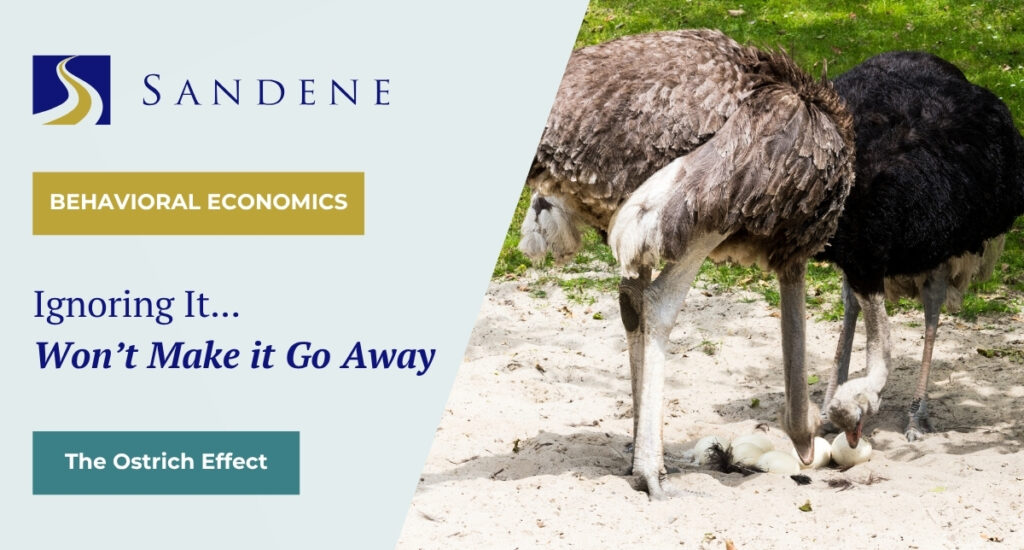
When a person refuses to face the reality of their situation, or constructs an alternative reality where everything is fine, they’re trapped by The Ostrich Effect, a cognitive bias.
Avoidance Can Compound a Negative Situation
The Ostrich Effect can lead to disastrous financial results in absolutely horrible bear markets, as well as thriving bull markets. In the worst incidences, the investors were heavily invested in the wrong side of the trend, refusing to admit the adverse impact of their poor decisions. Then they made things worse by ignoring information contrary to their misguided belief (Confirmation Bias).
The more common situation occurs during a steep downtrend, when investors, en masse, ‘bury their heads in the sand’ and fail to properly deal with the negative impact on their investment accounts.
Equity investors during the bursting of the dot-com bubble (2000-2002) and the Great Financial Crisis (2007-2009) know what it’s like to avoid opening their account statements or logging into their 401(k) accounts. For some investors this behavior persisted for months.
Since the market (always, eventually) rebounds, the investors who didn’t look and did nothing over those years, probably ended up okay.
The most serious investment mistakes were made by those who couldn’t help themselves and took a peek at their accounts, deep into the bear market, and were horrified by the magnitude of their losses. Then, at the worst possible moment, they sold all their stocks.
Those investors locked in their losses, experiencing 100% of the price decline and 0% of the recovery.
Sandene Strategies’ Investment Approach
At Sandene Strategies, we’ve studied behavioral economics and understand the adverse impact emotional and cognitive biases can have on investment portfolios. Our knowledge and experience have prepared us to advise our clients when they’re trapped by a bias.
Naming and explaining the source of their difficulty, and offering alternative solutions, makes it easier for them to initiate steps to resolve their situation.I’m passionate about this topic and would love to discuss these ideas in more detail with you. If you’re interested, shoot me an e-mail Jeff.Sandene@LPL.com or better yet, let’s schedule a conversation.