

When people think about planning for their retirement, their focus is directed almost exclusively at the numbers. How much money will I need? What will my living expenses be? How much should I be saving now? What rate of return do I need to get?
Clearly these are central questions that must be answered.
However, there’s more to consider.
I’ve maintained for quite a long time that personal financial planning is often more of a social science than a financial modeling exercise.
That’s because financial planning involves conversations with people about the complex human issues associated with money and life. It doesn’t take long for a CFP® to find themselves in deep discussions about dreams, fears, values, and interpersonal relationships, in addition to emotions and biases about money and investing.
These subjects are in the domain of sociology and psychology, rather than business and finance.
Relevant Living™ – Your New Beginning of Growth, Purpose, and Fulfillment
I’m currently completing the manuscript for my book, Relevant Living™ – Your New Beginning of Growth, Purpose, and Fulfillment. It’s entirely about the psychological and social issues people experience after they’ve retired by selling their business, saying “goodbye” to corporate America, or simply leaving the workforce.
In Relevant Living™, I challenge use of the term “retirement” to timestamp the end of one’s working career, and introduce the term “new beginning” to describe the new and great adventure that lies ahead.
Inevitably, people hit obstacles on their new beginning journey.
They’ll drift through some of their days without the structure of a regular routine.
If their social network was tied to their co-workers and business colleagues, they may experience loneliness and the loss of community.
Their relative inactivity and lack of a meaningful purpose could damage their self-esteem and perceived social status.
These can be difficult circumstances to face, with feelings of loss, grief, and even depression emerging over time.
The core of Relevant Living™ is seven exercises that will help people address these non-financial issues of their new beginning while they’re occurring, or better yet, in advance of their departure from the workforce.
Ascending Maslow’s Hierarchy Through Financial and Life Planning
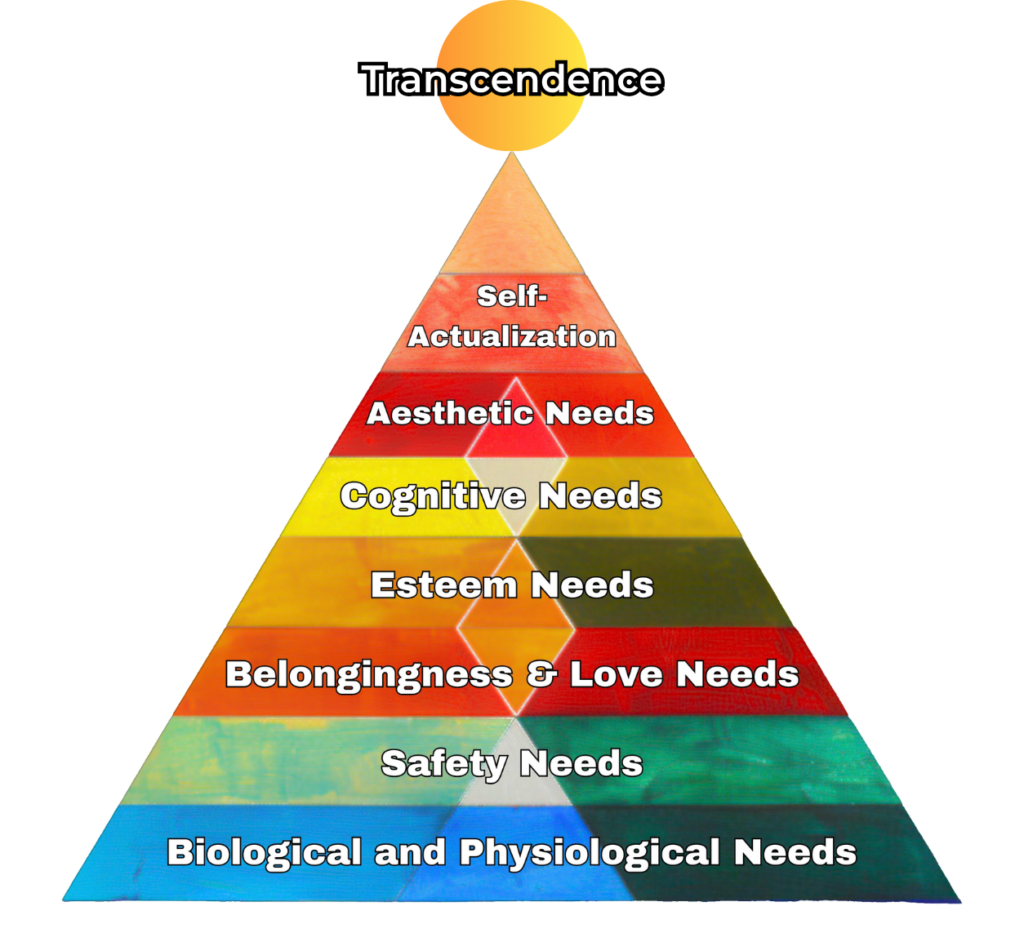
When developing the concepts of Relevant Living™, I noticed that Maslow’s Theory of Human Motivation1 and the iconic pyramid representing Maslow’s Extended Hierarchy2 was very applicable to the non-financial issues people experience after leaving the workforce. Many of these issues can be solved by satisfying the emotional needs described by Maslow.
Traditional financial planning addresses those issues that are directly and predominantly solved with money. On Maslow’s hierarchy those are the basic (deficiency) needs required for safety and to sustain human life.
Providing solutions to deficiency needs is where financial planning ends for most people.
However, once a person has the financial resources to eliminate worries about food, shelter, health, and personal security, they can consider and start addressing their psychological, experiential, self-fulfillment, and relevancy needs.
Most financial advisors aren’t equipped to help people identify and resolve their non-financial issues and meet their higher-level (growth) needs.
The Relevant Living™ process picks up where traditional financial planning leaves off, providing a framework for people to ascend Maslow’s Hierarchy.
Relevant Living™ and Maslow’s Hierarchy
When a person’s completing the seven exercises of Relevant Living™, ideas for addressing non-financial issues that occur after leaving the workforce by satisfying Maslow’s needs will be woven through the process. Here are some examples:
PSYCHOLOGICAL NEEDS – Maintaining and caring for your mental health.
- Belongingness & Love
Begin satisfying your need for friendships and social relationships through renewal and creation.- Who do you know, now and in the past?
- Who would you like to meet and associate with?
- Where have you met people in the past?
- Where will you find people you’d like to meet?
- Esteem
Support your self-esteem, confidence, and achievement needs by trying new and different activities that are important and stimulating.- What have you done in the past that you enjoyed and were stimulated by?
- What do you wish you would have done in the past, but didn’t have the time or resources?
EXPERIENTIAL NEEDS – Expand your mind and your environment by going to new places and seeing new things.
- Cognitive
Stimulate your intellectual curiosity by pursuing knowledge, understanding, and discovery.- What current interests do you have that you’d like to learn more about?
- What subjects have always interested you, but you’ve never sought answers to your questions about it?
- Aesthetic
Arouse your senses by appreciating nature, art, music, food, beauty and find deeper meaning in the connectedness of your environment.
SELF-FULFILLMENT NEEDS – Satisfied by personal growth and achieving one’s highest level of personal potential.
- Self-Actualization
- Can you measure or compare what you do or want to do?
- Do you desire to pour yourself into something and reach peak performance?
RELEVANCY NEEDS – Serving others and society for the “greater good.”
- Transcendence
- How can you combine your beliefs and values with your accumulated knowledge and experience, and applying this unique set of attributes to something that’s beyond yourself.
These social and psychological issues related to planning for your new beginning, the period after you leave the workforce, are real.
Therefore, rather than waiting to deal with these non-financial issues when they occur, it makes sense to plan for them in advance, just like you create a plan for your finances.
I’m looking forward to sharing previews of the Relevant Living™ exercises with you in a few more of these special articles, written in advance of my book’s publication in 2027.
1 Maslow, A. H. “A theory of human motivation”. Psychological Review. July 1943, (Volume 50, Issue 4): 370–396.
2 Abraham H. Maslow, The Farther Reaches of Human Nature (New York: Viking Press, 1971)
The opinions voiced in this material are for general information only and are not intended to provide specific advice or recommendations for any individual. All performance referenced is historical and is no guarantee of future results. All indices are unmanaged and may not be invested into directly.